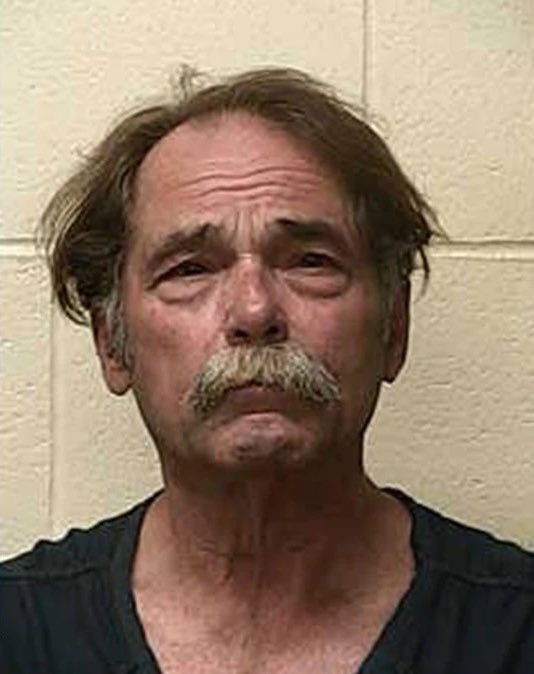
In 2020, Steven Yoder used Rex McCurdy to illustrate the alleged excesses of California’s sex-offender civil commitment system. The public record tells a much darker story.
In November of 2022, I was trying to understand the best arguments against sex-offender registries. If I was going to defend the registry, I needed to know what its critics were claiming. That search led me to Steven Yoder, a journalist who has spent years writing about sex-offender registries, residency restrictions, civil commitment, and other laws imposed on offenders.
It also led me to Rex McCurdy.
Yoder used sex offender Rex McCurdy in a 2020 article in Reason about California’s sexually violent predator program and an unfinished recidivism study conducted by psychologist Jesus Padilla. His telling was sympathetic. McCurdy had pleaded guilty to a rape, served his time, later committed a burglary, and then—according to McCurdy—was returned to custody in 1998 for living too close to a school. Prosecutors used the violation and his prior convictions to have him classified as an SVP, Yoder claimed.
By the end of the article, McCurdy had become Yoder’s proof of concept: “one prisoner-cum-patient who has not been arrested for a new sex crime.” The registry’s sexually violent predator label, Yoder concluded, had “nearly condemned him to a lifetime of imprisonment.” [1]
Then I typed Rex McCurdy’s name into a search engine.
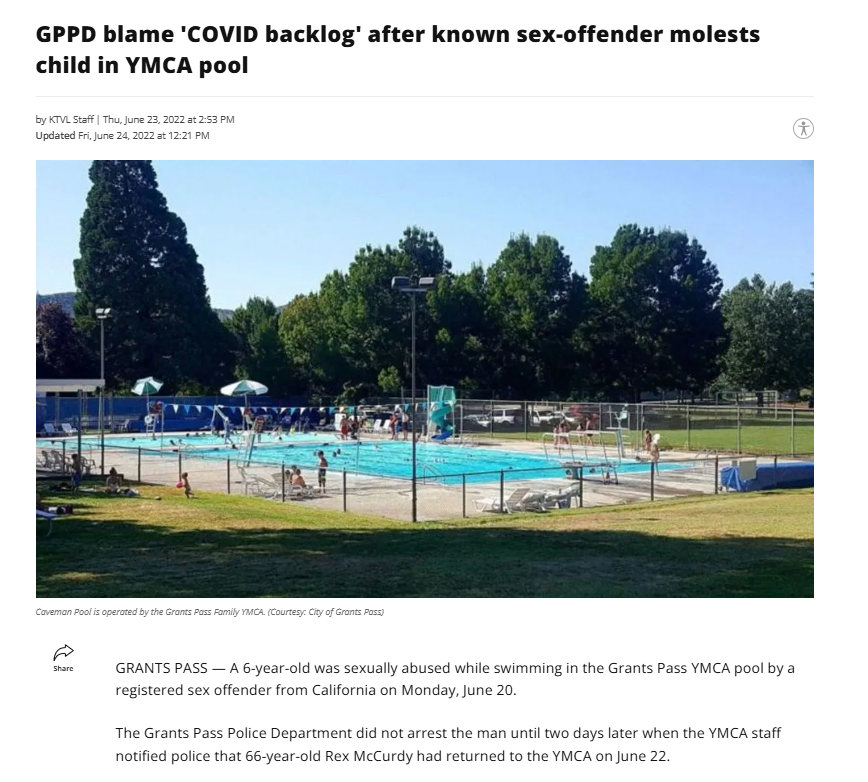
The first thing I found was not a decades old court dispute. It was a June 2022 report from Grants Pass, Oregon. A six-year-old girl had been molested in a YMCA swimming pool. Police identified the man as Rex McCurdy, a registered sex offender from California. Two days later, McCurdy returned to the YMCA and staff alerted police. Detectives arrested him on two counts of first-degree sexual abuse. [2] In 2024, a jury convicted McCurdy on two counts of sexual abuse. On April 29 of that year, an Oregon judge sentenced him to life in prison without parole. [3]
That is how the story ultimately ended.
No one needed to see two years into the future. McCurdy’s future dangerousness was the central issue in the proceedings Yoder was describing, and assessing danger is not a supernatural exercise. It requires examining the person’s history. Yoder apparently failed to look twenty-one years into the past.
Yoder ignores Rex McCurdy’s multiple violent sex crimes

Yoder’s article was not primarily a profile of McCurdy. Its main subject was California’s civil commitment system. But Yoder chose McCurdy as the face of that argument. Once he did that, McCurdy’s actual history mattered.
News reports on McCurdy’s 1999 SVP trial were not hidden in a sealed file. It appeared in the Napa Valley Register. According to the prosecution’s report at the time, McCurdy’s record began with juvenile burglaries in 1971 and 1973 and a home trespass in 1977. In 1978, a nineteen-year-old woman awoke to find him jumping into her bed and threatening to rape her. She escaped after distracting him with the prospect of smoking marijuana. [4]
The following year, the newspaper reported, McCurdy raped a sixteen-year-old girl in her home while her family slept. He also raped a nineteen-year-old woman who was babysitting. Within a month of the second rape, he burglarized three more homes and committed a lewd act against a nine-year-old child in one of them. In 1980, he was declared a mentally disordered sex offender and sent to Atascadero State Hospital. He was later returned to prison as “unamenable to treatment.” [4]
After McCurdy was paroled in 1985, a lewd act involving a neighboring girl was reported but not prosecuted. An attempted burglary returned him to prison in 1988. After another parole, he failed to register, absconded, and was arrested in Hawaii. [4]
In 1996, McCurdy was arrested over an alleged 1994 lewd act involving a young boy. That case was ultimately dismissed, and McCurdy was released in May 1998. The following month, he was arrested for allegedly violating a no contact with minors order by approaching a boy at a basketball court. They are part of the history placed before the court, not merely an address violation half a mile from a school. [4]
At the 1999 SVP proceeding, three state evaluators reportedly concluded that McCurdy met the criteria for commitment; a defense evaluator disagreed. The jury found McCurdy to be a sexually violent predator. [5]
Yoder’s abbreviated biography withheld facts central to the very question his story asked readers to consider: Was the state treating Rex McCurdy as dangerous because of one distant crime and an emotionally loaded label, or because evaluators and a jury had examined a persistent, escalating history involving multiple victims?
Readers of Yoder’s article were never given enough information to answer. Yoder completely white-washed McCurdy’s criminal past to a nauseating degree. It’s my opinion that Yoder deliberately went out of his way to hide the true facts about McCurdy. If it wasn’t deliberate, he lacks fundamental skills as an investigative journalist.
Turning a blind-eye to sex crimes is what pedophile apologists do best.
The imbalance in Yoder’s reporting is difficult to miss. When he reached the criminal history of his central example, he relied repeatedly on McCurdy. Because don’t you know, violent sex offenders are always honest, I swear.
The phrase “he says” is doing remarkable work in the opening. It tells the reader where a claim came from, but attribution is not verification. If a person formally adjudicated a sexually violent predator says prosecutors used an address violation and two old convictions to confine him, the next journalistic step is to inspect the truth.
Yoder reported that McCurdy claimed several state evaluators considered him low risk and Padilla was the only holdout. Coverage of the original 1999 proceeding reported the exact opposite: three state evaluators supported commitment and one defense evaluator opposed it. It is possible Yoder and the newspaper were describing different evaluations or different stages of the case. Yoder did not make that clear. [1][5]
Yoder described the SVP label as something applied long after McCurdy’s singular “sex crime.” That wording did more than simplify. It transformed a record involving extremely violent sex crimes into the story of one old mistake.
The people removed by that edit are real people, real victims, who deserve better than this fluffy nonsense coverage. They were the nineteen-year-old who awoke with a man threatening rape in her bed; the sixteen-year-old raped while her family slept; the nineteen-year-old babysitter; the nine-year-old child; and the children involved in later reports and allegations. Yoder made room for McCurdy’s lawyer, his art studio, his property, and his view of Padilla.
In my opinion, the victims do not matter to Yoder. Yoder is concerned for the predators, not the public. After reading the article, I don’t think he’s much concerned for his own reputation, or for the integrity of his work.
Yoder reduced a sustained pattern of predatory behavior to one singular rape
Yoder told his readers about only one rape. He then closed the article by calling McCurdy “one prisoner-cum-patient who has not been arrested for a new sex crime,” using the years after McCurdy’s release to suggest that the state’s assessment of him had been proven wrong. But Yoder had concealed the very history readers needed to evaluate that conclusion: multiple sexual offenses, multiple victims, children, repeated home invasions, failed treatment, parole violations, and the evidence presented during McCurdy’s 1999 sexually violent predator trial. This was not a harmless abbreviation. Yoder reduced a sustained pattern of predatory behavior to one singular rape and then treated the absence of a recent arrest as McCurdy’s vindication. Readers were never told enough to recognize how misleading that conclusion was.
The danger Yoder’s framing minimized was real, identifiable, and supported by a record of repeated conduct. McCurdy was not an unlucky example who later took an unforeseeable turn. You don’t need a psychic, or even a group of psychologists to read into McCurdy’s future. McCurdy should have never been released, and at least one six-year old girl paid the price for the leniency that’s given to sexual predators.
Yoder Flunks His Own Ethics Test

Yoder has built much of his career writing against sex-offender registries and related restrictions. NARSOL lists him in its speakers bureau, where his advertised topics include registry law, the consequences of registration, strategies for rolling back residency restrictions, and media advocacy. The organization has also featured him as a speaker and promoted or republished his work. Although NARSOL’s website states that Yoder is not formally affiliated with the organization, he is a prominent ally within the registry-reform movement. [6]
The irony is less than amusing. In an article lecturing other journalists about ethics, Yoder warns against stories that merely look investigative, insists that reporters tell “the whole truth,” and urges them to exercise “objectivity and independent judgment.” [7]
McCurdy exposes the weakness in Yoder’s own advice. Yoder used group statistics to cast doubt on the state’s assessment of McCurdy while failing to investigate the individual record that bore directly on McCurdy’s risk. He meticulously investigated the institution he wanted to discredit but barely investigated the offender he wanted readers to sympathize with. The man who warned other reporters against work that only looks investigative produced exactly that kind of reporting when it served his own interests. The ethics article practically writes its own punchline.
Judge: McCurdy is “one of the nightmares that keep parents up at night”
The Grants Pass YMCA said it conducted state and federal background checks and had denied memberships when applicants raised concerns. According to the police statement, pandemic-related restrictions or backlogs prevented McCurdy’s California registration status—and that of his companion—from appearing during the check. [2] There’s an implication here that McCurdy not only went to the YMCA to molest children, but that he had teamed up with another sex offender to prey on children.
The registry therefore did not prevent McCurdy from entering the facility. But that is not evidence that his status was useless. The YMCA was trying to obtain precisely the information Yoder treated as a stale and destructive label.
After the brave six-year-old girl reported the abuse, YMCA staff helped identify McCurdy and notified law enforcement when he returned on June 22. Police expressed concern that there might be additional victims because McCurdy had frequented the facility with a male companion. [2]
Nearly two years later, a jury found McCurdy guilty on two counts. At sentencing, the prosecutor cited prior sex-crime convictions from three California counties and sought life without parole. [3][8] McCurdy’s attorney asked for seventy-five months and argued that the prior convictions were old. Judge Brandon Thueson imposed life without parole. He called McCurdy “one of the nightmares that keep parents up at night.” [3]
The omissions can no longer be dismissed as harmless
McCurdy’s 2022 crime was not a bolt from a clear sky. By 2020, Yoder could have known that McCurdy’s history extended far beyond one rape and one burglary. He could have found the two women raped in 1979, the attempted rape, the child molestation during a burglary, the earlier mental-health commitment, the failed treatment placement, the parole cycles, the dismissed child-sex case, the no-contact allegation, the competing evaluators, and the jury’s verdict. He could have told readers which facts were convictions, which were allegations, which were disputed, and which came only from McCurdy.
That is what risk assessment is supposed to do: draw meaning from a demonstrated pattern before another victim is harmed. Yoder instead treated the state’s warning as the injustice and McCurdy’s freedom as the vindication. The six-year-old at the YMCA was the consequence of a danger that had already been identified, litigated, and documented. Instead, he investigated the institution and trusted the offender.
That choice mattered because Yoder was not writing about an abstraction. His work asks the public to reconsider laws created for the safety of children.
Rex McCurdy is now serving life without parole. His 2024 conviction confirmed the central warning Yoder’s framing minimized: McCurdy continued to present a serious danger to the public. The omissions can no longer be dismissed as harmless background.
The warning wasn’t hidden in some sealed. It was sitting right there in the archives. It would have taken Yoder a few minutes to find it. But why bother checking the record when it’s just children’s safety at stake? Yoder didn’t need a crystal ball. He just needed to do his job. Apparently, that was asking too much.

“The Truth Could Set Them Free.” No, no. The truth will set you free, but first it will piss you off. Maybe that’s why Yoder left so much of it out.
Sources
- Steven Yoder, “After He Found California’s Indefinite Detention of Sex Offenders Wasn’t Working, the State Shut Him Down and Destroyed His Research,” Reason, March 1, 2020. https://reason.com/2020/03/01/the-truth-could-set-them-free/
- Grants Pass Police Department, “Child Predator Arrested in Grants Pass,” June 23, 2022; KTVL, “GPPD Blame ‘COVID Backlog’ After Known Sex-Offender Molests Child in YMCA Pool,” June 23, 2022. https://flashalert.net/id/GrantsPassPublicSafety/155525 and https://ktvl.com/news/local/california-sex-offender-arrested-for-touching-6-year-old-in-grants-pass-ymca-pool-rex-mccurdy-josephine-county-sheriffs-office
- KOBI-TV NBC5, “Man Sentenced to Life in Prison After Sexually Abusing Young Girl,” April 29, 2024. https://kobi5.com/news/local-news/man-sentenced-to-life-in-prison-after-sexually-abusing-young-girl-227106/
- “High-Risk Registered Sex Offender Rex Allen McCurdy…,” Napa Valley Register, May 27, 1999, Newspapers.com images 565829147 and 565829150. https://www.newspapers.com/image/565829147/ and https://www.newspapers.com/image/565829150/
- Napa Valley Register, June 4–5, 1999, including “Sex Offender Denies He’ll Offend Again” and coverage of the SVP verdict. https://www.newspapers.com/image/565561301/ and https://cdnc.ucr.edu/?a=d&d=NVR19990605.1.1
- NARSOL, “Speakers Bureau: Steven Yoder”; NARSOL, “Conference 2023—A Success Story, Inside and Outside.” https://www.narsol.org/speakers-bureau/ and https://www.narsol.org/2023/06/conference-2023-a-success-story-inside-and-outside/
- Steve Yoder, “To Journalists: Consider the Ethics of Truth About Registered Citizens,” NARSOL, August 13, 2017. https://www.narsol.org/2017/08/to-journalists-consider-the-ethics-of-truth-about-registered-citizens/
- Oregon Revised Statute 137.719, “Presumptive Life Sentence for Certain Sex Offenders Upon Third Conviction.” https://www.oregonlegislature.gov/bills_laws/ors/ors137.html
- Tamara Rice Lave and Franklin E. Zimring, “Assessing the Real Risk of Sexually Violent Predators: Doctor Padilla’s Dangerous Data,” American Criminal Law Review 55 (2018). https://repository.law.miami.edu/fac_articles/578/