Some interesting developments occurred since the publication of Part One. I could not have anticipated that one of the subjects of Part One would show up in the comments section after Mongo’s recent passing.
When I published Part One, I had already found an intriguing possible point of contact between Prince Mongo and the Memphis-Marks child trafficking case. In 1980 Winsor Stockton, Marvin Ray Driggers, and Joe Benson were arrested in connection with a multistate child-trafficking and CSAM production operation. Stockton and Driggers were incarcerated without incident, but the wealthy Benson went on the run for five months, before being arrested by federal agents. [1, 2]
Last month, my suspicions over Mongo being a potential pedophile, mounted when I came across a nearly two year old comment. I examined the public allegation made by a brave Memphis-area commenter. Because the precise wording matters, this is what the commenter wrote:
“Little known fact about ole Prince Mongo . He had a insatiable appetite for young boys to the point he was nearly rounded up with Windsor Stockton and Ray Driggers down in Mississippi for transporting boys from 7-15 years old. Prince Mongos awesome speedboat pulled them right in. He had money so he testified against the others. He went on to have some of the best clubs that catered heavily to the underage .! He is such a great person. All these facts are readily available. He literally love’s little boys !” [3]
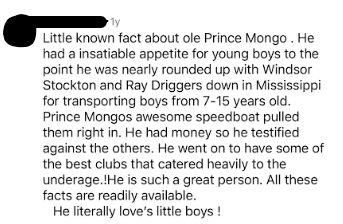
This is a claim, not a proven account. However, it contained unusually specific names, a place, an age range, a boat and a supposed explanation for why Mongo was not prosecuted with the others.
I pored over my Prince Mongo notes alongside the records I had compiled on the Memphis–Marks case, searching for any place where the two histories might intersect. Then I found one.
Winsor Stockton and Prince Mongo at Juvenile Court
In March 1969, a Memphis newspaper reported that Bob Hodges—aka Prince Mongo—and his chimpanzee, Coco, “put on little shows for children in hospitals, orphanages, and Juvenile Court.” At that very time, Winsor Stockton was employed as a counselor at Shelby County Juvenile Court, where he worked from November 1965 until June 1969. The article does not prove that Hodges and Stockton met, or that Stockton was present for one of Coco’s performances. It does, however, place Hodges inside the same institution where Stockton worked, during the same narrow period—the first documented overlap I had found between Mongo and one of the men named in the allegation. [4, 5]
It ‘s an overlap. It’s not proof the two men had met. Still, it was more than I expected to find.
Then, almost immediately after publishing Part One, I searched Facebook again for one of the convicted men’s names + Prince Mongo. I had run the same search before. This time, because Mongo had died and people were talking about him again, there was something new.
Marvin Ray Driggers commented on a post about Mongo’s passing
“His name is Robert Hodgens,” Driggers wrote. “He was a Fraternity brother of mine in Kappa Sigma at Memphis State University before the name change to University of Memphis.” [6]
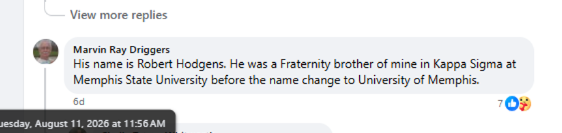
He appears to have added an n to Hodges. The important part was perfectly clear: Driggers was publicly claiming that he knew Mongo! Not merely in passing. He remembered him as a fraternity brother.
That was a turn of events.
I had verified that Stockton and Driggers were real people connected to a real multistate child-trafficking operation. The fact that the commenter remembered those long forgotten names more than forty years later was what made the allegation difficult to dismiss. But I could not establish the central connection: that either man had actually known Prince Mongo.
Now one of those men had answered that question himself.
This does not prove the allegation. It does not prove Mongo participated in the crimes that sent Driggers to prison. It does not even settle whether “fraternity brother” was literally accurate.
But Ray Driggers says he knew Mongo.
And then I found his second comment.
On another Facebook post, this one about Ashlar Hall, Driggers wrote:
“Ashley Hall. What a super place. Been there many times when it was a bar Owned and ran by Prince Mongo aka Spirit and Kappa Sigma fraternity brother.” [7]
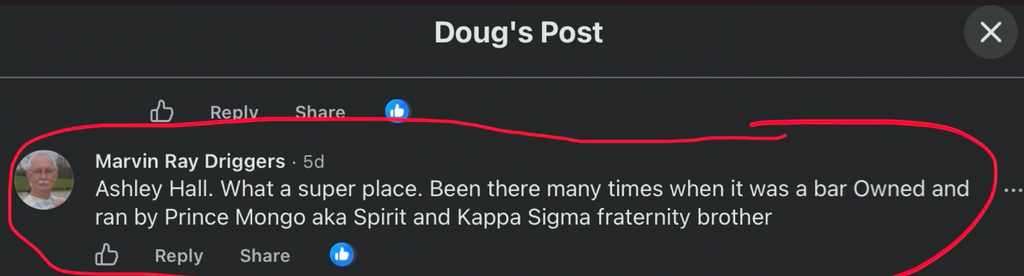
He wrote Ashley, but another commenter corrected the name to Ashlar. The words are clumsy, but, Driggers said he had been there many times when the building was a bar owned and operated by Prince Mongo.
Then I found a third comment from Driggers, this one written directly as a farewell to Mongo:
“Rest in Peace my Spirit. You were one of a Kind. So Blessed to be yourself friend 🧡” [8]

Driggers called Mongo “my Spirit” and described himself as blessed to be his friend. His own words suggest a closeness, not merely a distant campus character remembered decades later.
Well, well, well.
The first comment placed Driggers and Mongo together in the Memphis State fraternity world. The second carried the relationship forward by decades. The third described it in unmistakably personal terms. Ashlar Hall entered the Hodges family’s hands in 1993, more than twelve years after Driggers pleaded guilty in the Memphis-Marks case. [2, 9] By Driggers’s own account, he was repeatedly visiting Mongo’s establishment after his imprisonment, and he considered Mongo a friend.
Yes, It Is That Ray Driggers

A Facebook name alone is not enough. People share names. So I went back through the records.
The 1967-68 Memphis State University student, faculty and staff directory lists Marvin Ray Driggers by his full name. [10] The university’s 1969 DeSoto yearbook lists Marvin Driggers among the undergraduates and Ray Driggers among the members of Kappa Sigma’s Epsilon Pi chapter. [11]
The newspaper archive makes the identification even cleaner. A May 1968 campus column in The Commercial Appeal announced Kappa Sigma’s new officers and named Ray Driggers as secretary. [12] A September 1969 photograph in the Memphis Press-Scimitar identified him as one of the Memphis State cheerleaders performing for first-graders at the university’s laboratory school. [13]
None of those records mentions Mongo. They establish Driggers’s side of the claim: he really was a Memphis State student, a Kappa Sigma officer and a highly visible participant in campus life.
The age also fits. Reports described Ray Driggers as thirty-three when he was arrested in 1980. [14] His birth date, education, full name, and later Memphis history also align with public records.
Before the Arrest, Driggers Was Ousted From Coaching Basketball
The newspaper biography of the man behind that Facebook profile makes the story considerably more disturbing.
In 1974, the Memphis Press-Scimitar introduced twenty-six-year-old Ray Driggers as Westside High School’s new head basketball coach. The profiles cast him as an energetic young disciplinarian: he imposed a 9:30 p.m. curfew, required his players to wear coats and ties to school, and later made the entire team run cross-country. One article praised him as “living proof” of positive thinking and “a coach who talks about his kids first.” [15, 16]
By 1976, Driggers had moved to Oakhaven High School as head coach. Then, in November 1977, officials abruptly removed him from coaching and transferred him to a noncoaching position at Hamilton High School. The superintendent and other administrators refused to explain why, saying only that the move was in the school’s and Driggers’s “best interest.” Driggers, acting on his attorney’s advice, also declined to comment. [17, 18]
Students angry at the perceived mistreatment of Driggers, and their loss of playing basketball, walked out in protest. The Memphis Education Association investigated. The strangest wording came from an Oakhaven booster chairman, who said he had seen no evidence “to prove guilt of the charges against him.” Neither the newspapers nor school officials explained what those “charges” were.. [18, 19, 20]
A Defiant Driggers
Later that year, Driggers made the news again during a teachers’ strike. In October 1978, he was arrested on a warrant for blocking a school entrance and disorderly conduct. The warrant had been sworn out by an Oakhaven assistant principal. [21]
I can’t invent an explanation for the 1977 transfer. But whatever prompted it was serious enough that school officials refused to elaborate publicly and Driggers declined to comment on the advice of his attorney. That raises an eyebrow, even if it does not answer the question. By the time the Memphis–Marks investigation reached Driggers in 1980, reporting identified him as a Hamilton High School teacher. [14] None of the school articles accused Driggers of abusing a student or player.
But the biography is still haunting. Before Driggers pleaded guilty in a case involving the sexual abuse of boys, he had spent years as a junior-high and high-school basketball coach with authority over adolescent boys.
This is the same Marvin Ray Driggers who was indicted with Winsor Stockton and Joe Eddins Benson Jr. in Quitman County, Mississippi. In 1981, Driggers pleaded guilty to conspiracy to commit what Mississippi law then called “unnatural intercourse.” He received a five-year sentence, with the final two years suspended, and was ordered not to associate with males under eighteen during the full five-year period. [2]
Driggers now says Robert Hodges was his Kappa Sigma fraternity brother, that he visited Mongo’s Ashlar Hall “many times,” and that he felt blessed to have been Mongo’s friend. Because Mongo did not begin operating Ashlar Hall until around 1993, Driggers was describing a relationship that continued after his imprisonment.
That timing is disturbing because Mongo’s pizza parlors and Ashlar Hall were widely known as high-school hangouts where teenagers went to get blackout drunk. Public accounts from named former patrons contain darker allegations. A Memphis woman, writing under her real name, alleged that some young patrons were surreptitiously drugged and that Mongo gave LSD to teenagers. Another man publicly claimed that Mongo poured him a shot, told him there were poppers behind the bar and appeared to be making a pass at him.
Those allegations are not the same as independently established facts, but neither are they anonymous internet whispers. Underage patronage was not some incidental flaw in Mongo’s establishments; by account after account, it was a defining feature. Placed beside Driggers’s admission that he visited Ashlar Hall repeatedly after his imprisonment, the picture becomes more unsettling.
That does not prove Hodges participated in the crimes that sent Driggers to prison. It does, however, eliminate the convenient possibility that Mongo and every man named in the allegation were complete strangers.
One of them certainly was not.
Fraternity Brother — or Campus Ghost?
Long before I found Driggers’s comment, I had encountered whispers about Mongo and Memphis State.
There was never just one story. Some people remembered that he had attended the university. Others suggested that he taught there or simply spent a great deal of time around campus. One recollection placed him playing racquetball at night with Elvis Presley. That was the flashiest version, so naturally it attracted my attention, but it was part of a larger collection of memories placing Hodges somewhere inside the Memphis State world.
None of those accounts came with evidence.
There was, however, one period-specific recollection already sitting in my notes. A former business manager of the Memphis State student newspaper, the Tiger Rag, later wrote that Mongo—then still Robert Hodges of the Dalion Et Rae men’s store—held an annual advertising contract with the paper in 1967–68 and “did quite a bit of advertising.” [22] It is an online recollection, not a university record, and it does not place Hodges in a classroom or on a fraternity roll. It does show that his business was actively courting the Memphis State community during the same academic year in which Driggers appears in the university directory.
Driggers’ comment changes their weight. For the first time, someone whose presence at Memphis State and membership in Kappa Sigma can be independently verified has placed Hodges in that same environment.
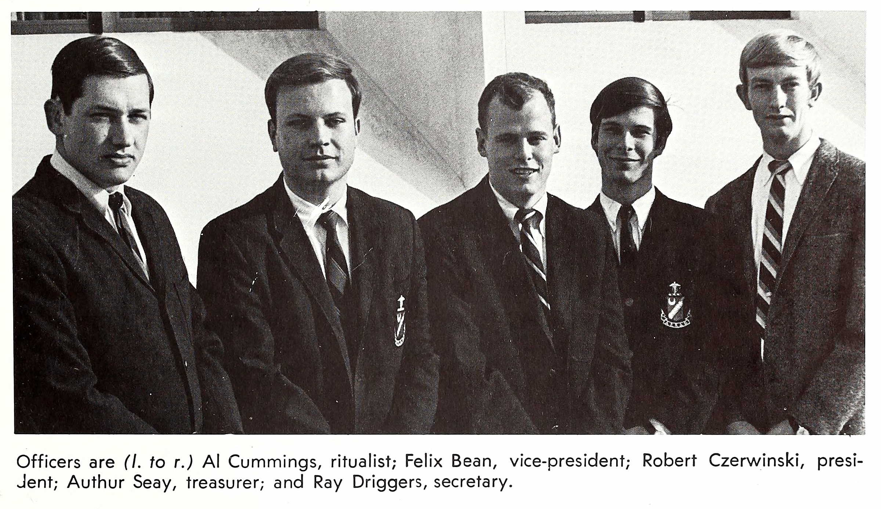
I still cannot confirm that Hodges was formally enrolled at Memphis State. He does not appear under “Robert Hodges” in the 1967-68 university directory, and I have not found him among the undergraduates or Kappa Sigma roster in the 1969 yearbook. [10, 11]
His later presence on campus, however, is documented. Memphis State’s 1980 DeSoto yearbook included Hodges in a feature titled “MSU Welcomes Local and National Guests.” It reported that the Student Government Association invited the four 1979 Memphis mayoral candidates to appear and that three accepted: Pat Halloran, Otis Higgs and Robert “Prince Mongo” Hodges. [23] This doesn’t establish enrollment—and it occurred roughly a decade after the period Driggers appears to be describing.
That absence matters, but it is not conclusive. Hodges may have attended part-time, belonged to Kappa Sigma through another institution, associated with the Memphis chapter as an alumnus, or been remembered more formally than the facts justify.
Hodges would have been about thirty-two during the 1967-69 academic years, older than the typical undergraduate. He was already established in Memphis, operating a men’s clothing business on Union Avenue and developing the marketing instincts that would later become Prince Mongo.
Regardless of Hodges enrollment status, Driggers remembered Hodges as part of his fraternity life nearly sixty years later. Their relationship existed before Prince Mongo became a Memphis legend.
One newspaper report adds another, equally unverified wrinkle. During a 1980 federal insurance hearing, courtroom observers were told that Hodges was a Columbia University graduate and had run an import-export business in New York before moving to Memphis. [24]
Mongo and Winsor Stockton both at Juvenile Court
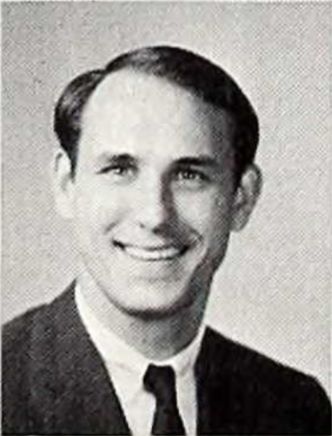
Memphis State University 1966
Before Driggers supplied this direct connection, the strongest potential point of contact I had found involved a chimpanzee named Coco.
In the late 1960s, Robert Hodges aka Mongo and Taman “Tom” Aseff operated a men’s clothing store in Memphis. By the summer of 1968, the store had acquired the male chimpanzee. Coco wore clothes, appeared in advertisements and became part mascot, and traveling attraction for children.
A March 1969, profile reported that Mongo had taken Coco to orphanages, children’s hospitals and Juvenile Court. The article identified Hodges and Aseff as co-owners and captured an early version of the showman who would later become Prince Mongo from Zambodia. [4]
The date is important.
Winsor Stockton worked as a probation counselor in the Shelby County Juvenile Court’s central detention intake area from November 1965 until June 1, 1969. Juvenile Court officials later said he was fired for “unsatisfactory performance.” [5]
The overlap is difficult to shrug off. Stockton had been working inside institutions for vulnerable boys since he was still a boy himself. In 1960, while attending high school, he worked as a recreational counselor at Memphis Boys Town, where his father, Joe Stockton, was executive director. Former residents would later accuse the elder Stockton of brutal punishment, including beatings with a leather belt kept in a freezer; one described him as “a sadist and a child abuser.” These are retrospective allegations, but they place Winsor’s earliest professional access to boys inside an institution controlled by his own father.
By November 1965, Stockton had become a probation counselor at Shelby County Juvenile Court—a position he held until June 1969, when he was fired for the maddeningly vague reason of “unsatisfactory performance.” The surviving report does not say that his dismissal involved sexual misconduct. What it does establish is that Stockton was still employed at Juvenile Court during the same narrow period in which newspapers reported Prince Mongo bringing Coco there to entertain children. That does not prove the two men met, but it places Stockton and Mongo, whose repeated access to children is now under scrutiny, within the orbit of the same juvenile institution at the same time.
In other words, the newspaper placed Hodges bringing Coco into Juvenile Court during the same period Stockton worked there.
I have not found any additional material, or witness who places them together.
But this is no longer a vague claim that two Memphians might once have crossed paths somewhere in the same city. Hodges was going to the same institution where Stockton worked, during Stockton’s documented employment. That is a legitimate opportunity for contact.
On its own, it remained a thin bridge.
Then Driggers identified Mongo as his fraternity brother.
Now there are two separate lines placing Mongo near men later convicted in the same case: a direct personal claim from Driggers and an institutional overlap with Stockton.
Reading the Comment Again
When I first found the allegation, its most remarkable feature was specificity. They named Winsor Stockton and Ray Driggers. They placed the activity in Mississippi. He referred to transporting boys between seven and fifteen years old.
Stockton and Driggers were indicted in Mississippi and that the investigation involved boys from multiple states. Different reports described victims from Tennessee, Mississippi, Georgia, Pennsylvania and Florida. Some placed their ages between seven and fifteen, the same range the commenter used decades later. [1, 5]
That does not tell me where the commenter learned the story. They may have known someone involved, experienced something first hand, remembered news coverage, or repeated a rumor that mixed truth with embellishment. But the independently verifiable pieces of his comment continue to accumulate.
They claimed that Driggers knew Mongo. Driggers has now made that claim himself three times.
They claimed Mongo had a speedboat. A 1975 newspaper account quoted one of Hodges’s neighbors complaining that he kept several cars, motorcycles, and a boat outside his Eastmoreland home. [25] A television interview from the 1990s also showed Mongo’s yacht in Florida. [31 ] That establishes only that Hodges apparently owned or possessed a boat—not what kind it was or what he did with it.
Finally, the commenter claimed Mongo avoided arrest because he had money and testified against the others. I have no record naming Hodges as a suspect in the Memphis-Marks investigation.
I plan to send a FOIA to the FBI and Marks but it’s unlikely I would ever have access to grand jury testimony, though some other important information may be gleaned, depending on what I can recover.
The Film Processor

I have also continued trying to understand James Woodrow Smith, the California link in the case.
Smith was thirty-two years old and originally from Mississippi. Reports described him as a former Memphian employed by a commercial film processing lab in Burbank. Investigators believed illicit photographs from the Memphis-Marks operation were normally sent to California for processing and that Smith was the intended recipient. [1, 26]
Smith died from a shotgun wound to the head in his garage on March 25, 1980, one day after Stockton was first detained and the same day police searched Stockton’s apartment. His death was ruled a suicide. [26]
The surviving reporting does not give us the neat confession that later retellings invite us to imagine. Burbank detective Walt Lencki said Smith had recently appeared worried and depressed, but also said Smith was not being investigated by his office. Two friends said they had never heard him mention Stockton. Smith left a note, but the note reportedly gave no reason for his death. [26]
Memphis authorities nevertheless believed Smith had learned about the raid. How he might have learned, what investigators had told California authorities and whether Smith actually processed any of the seized material remain unclear.
To the casual observer, Smith’s timing suggests an obvious explanation: investigators were closing in on a child-trafficking and CSAM production operation, and guilt or fear overwhelmed him. But anyone familiar with how such networks can function may see a darker possibility.
A man who processed photographs depicting the abuse of children could have known far more than the names printed in the newspaper, particularly if the material implicated people with money or institutional protection. That does not prove this ring extended into more powerful circles, nor does it prove Smith was silenced. It does, however, make his position potentially dangerous. Perhaps the guilt consumed him. Or perhaps someone understood that dead men tell no tales.
I’ll be doing more research into Smith and a single article dedicated to him will be forthcoming.
Joe Benson a Pedophile in Pensacola
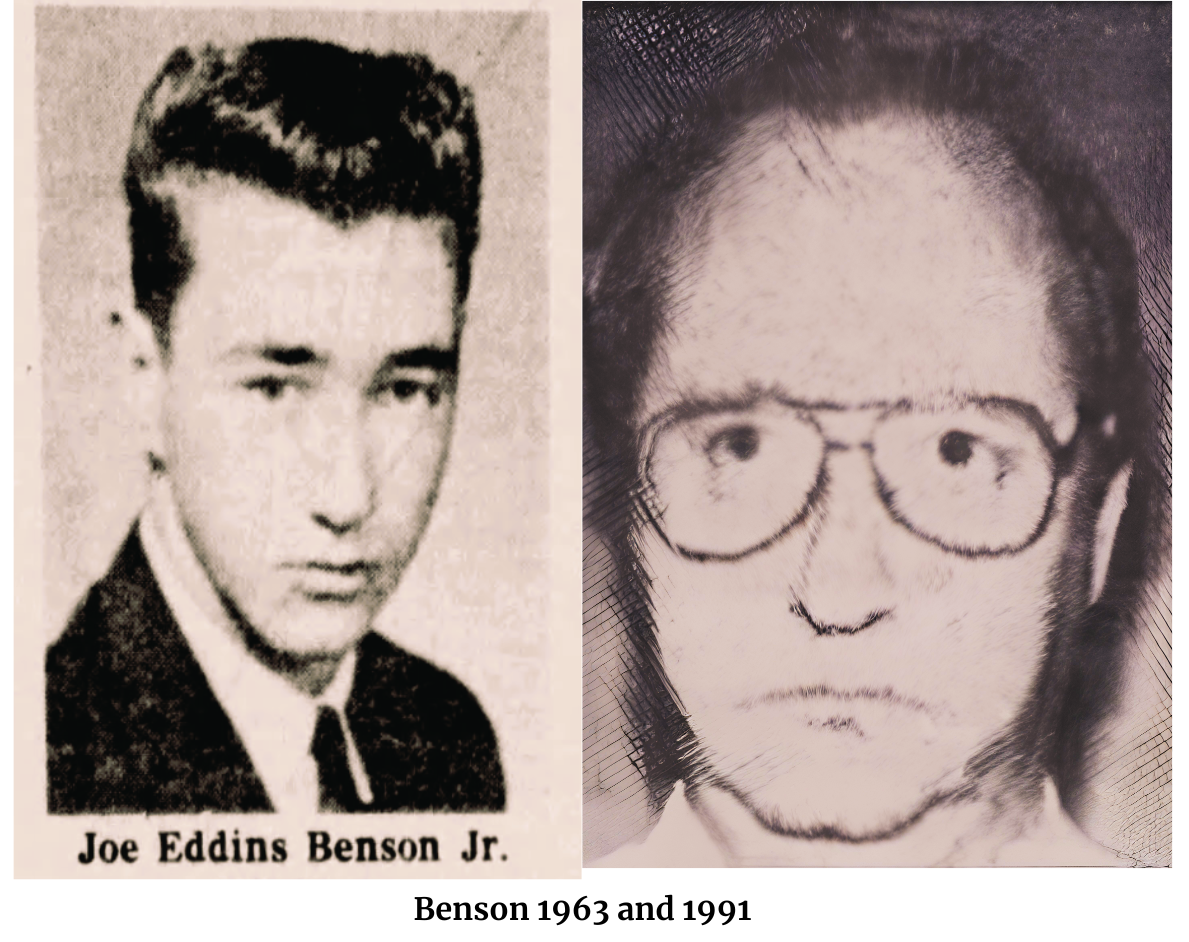
While the Mongo connection sharpened, the story of Joe Eddins Benson Jr. became worse.
Part One followed Benson through the raid on his barred farmhouse, his months as a fugitive, his arrest at Memphis’s Rivermont Hotel and his eventual guilty pleas. The case ended in 1981 with prison sentences, suspended time and additional Quitman County indictments expected to be “retired to the files.” [2]
The public story did not end there.
Ten years later, Benson resurfaced in Pensacola, Florida.
In March 1991, the Pensacola News Journal reported that Benson had been arrested in another case involving photographs of boys and material authorities described as child pornography. According to the newspaper, Benson told the boys to whom he showed CSAM that the material came from eighty-five Mexican boys he had adopted. [27]
I have not located any independent reporting substantiating a program involving eighty-five Mexican orphans. The claim should therefore be presented as Benson’s reported explanation, not as a fact. Regardless, Benson’s explanations are sickening. I can only hope it wasn’t true.
In what appears to have been an extraordinary miscarriage of justice, a July 1991 follow-up reported that the Florida case ended with probation. Police had interviewed several young boys and found hoards of candy, CSAM, and a catalogue advertising CSAM for sale in Benson’s apartment. Even with his prior record, Benson received probation. [28]
The first time, he was the generous farmer who bought clothing, motorcycles and even an education for vulnerable children. The second time, according to the Pensacola report, he was the benefactor of dozens of Mexican orphans, and kids around Pensacola.
By 1991 CSAM laws were firmly in place. How Benson managed to stay out of prison, given those charges, and his prior record of child-trafficking can not easily be explained, though I doubt being wealthy hurt.
By 2000, an obituary for Benson’s mother again listed Ed Benson as living in Marks. [29] I have not located any subsequent reporting on Benson.
So Where Does This Leave Mongo?
When I began, I had an allegation containing two forgotten names. I verified the men had committed those crimes, but the line to Mongo remains speculative. Now one of those men has drawn the line himself, extended it into the 1990s and called Mongo his friend.
By Driggers’s own public account, he and Robert Hodges were fraternity brothers at Memphis State. The university and newspaper records confirm Driggers’s presence and Kappa Sigma membership, although Hodges’s status remains unresolved. Driggers has also said he went to Ashlar Hall many times while Mongo owned and operated it. Because Ashlar Hall did not enter the Hodges family’s hands until 1993, that statement carries their association beyond college and beyond Driggers’s imprisonment. And in a separate condolence, Driggers called Mongo “my Spirit” and described himself as blessed to be his friend. [7, 8, 9]
Hodges also appeared at Shelby County Juvenile Court with Coco during the final months of Winsor Stockton’s employment there. That provides an opportunity for contact, not proof that contact occurred.
The original Facebook allegation accurately preserved the names, Mississippi setting, approximate victim ages and interstate movement associated with the original case. It also contained claims about Mongo’s supposed cooperation that remain unverified. This is where exploratory research becomes uncomfortable.
I cannot say the allegation has been proven. I can no longer say I have found no direct connection between Mongo and the men it named.
The honest conclusion lies in the irritating middle: Ray Driggers says Mongo was his fraternity brother, says he later frequented Mongo’s bar, calls him “my Spirit” and a friend. Still, I don’t know what that relationship meant. But it certainly means something.
For now, the story remains open.
Part One began with the wrong roll of film. Part Two began with the right man leaving a public comment.
The question is no longer whether Prince Mongo knew anyone named in the allegation. Driggers says he did, first at Memphis State and later through the world surrounding Ashlar Hall. He also says they were friends.
“The past is never dead. It’s not even past.”
—William Faulkner
Note on reporting: I did not contact Ray Driggers directly. Given his age, the sensitivity of the subject, and my position as an independent researcher, I relied on contemporaneous reporting, public records, and Driggers’s own public statements. Allegations, established facts, and my interpretations are identified separately.
Sources and Working References
- “Prominent Planter Sought in Pornography Case,” The Memphis Press-Scimitar, April 1, 1980, p. 15
- “Three Plead Guilty in Sex Case,” The Commercial Appeal, March 28, 1981, p. 3:
- Public Facebook allegation linking Prince Mongo to Winsor Stockton and Ray Driggers, preserved in the author’s Prince Mongo research notes and captured before publication of Part One
- Profile of Coco, Robert Hodges and Taman Aseff, The Memphis Press-Scimitar, March 5, 1969, p. 11
- Coverage of Winsor Stockton, the Memphis Boys Town and Shelby County Juvenile Court, The Jackson Sun, April 2, 1980, p. 9
- Marvin Ray Driggers, public Facebook comment beneath “Just heard that Prince Mongo has passed. Any truth to this?”, Things That Aren’t in the Memphis Area Anymore, captured August 17, 2026
- Marvin Ray Driggers, public Facebook comment about Ashlar Hall, captured August 17, 2026:
- Marvin Ray Driggers, public Facebook condolence comment on Prince Mongo’s death, captured August 17, 2026; screenshot supplied with the author’s research files.
- Reporting on the 1993 sale of Ashlar Hall to Bernard Hodges and the Hodges family’s operation of the property, The Commercial Appeal, December 10, 1993, p. 22:
- Memphis State University Faculty-Staff-Student Telephone Directory, 1967-1968
- DeSoto (Memphis State University yearbook), 1969, undergraduate index and Kappa Sigma Epsilon Pi chapter roster, pp. 320-21 and 367,
- “Campus Spirits Sag—Temporarily—Under Slow Grind of Exams,” The Commercial Appeal, May 19, 1968, sec. 5, p. 6; article supplied with the author’s research files.
- “Dress Rehearsal,” photograph caption identifying Memphis State cheerleaders, The Memphis Press-Scimitar, September 19, 1969, second sec., p. 11; article supplied with the author’s research files.
- Reporting on Marvin Ray Driggers during the Memphis-Marks investigation, The Commercial Appeal, July 28, 1980, p. 13
- Steve Kelley, “New Westside Story,” The Memphis Press-Scimitar, December 3, 1974, p. 17; article and team photograph supplied with the author’s research files.
- Larry Rea, “Driggers’ Power of Positive Thinking Gets Results,” The Commercial Appeal, November 8, 1975, p. 30; article supplied with the author’s research files.
- Larry Rea, “Melrose, Treadwell Rely on Team Efforts,” in “MCAA Cage Race Will Be Tight,” The Commercial Appeal, November 28, 1976, sec. D, p. 3; article supplied with the author’s research files.
- Jimmie Covington, “Oakhaven Students Visit School Chief To Protest,” The Commercial Appeal, November 30, 1977, p. 46; article supplied with the author’s research files.
- “MEA To Study Shift Of Coach,” The Commercial Appeal, December 3, 1977, p. 4; article supplied with the author’s research files.
- “Oakhaven Booster Chairman Resigns Over Coach’s Change,” The Memphis Press-Scimitar, December 6, 1977, p. 13; article supplied with the author’s research files.
- Report on Marvin Ray Driggers’s arrest during the Memphis teachers’ strike, October 13, 1978
- Recollection by a former Tiger Rag business manager concerning Dallion Et Rae’s 1967–68 advertising contract, preserved in the user’s Prince Mongo research notes: https://csnbbs.com/thread-197459-post-2052389.html
- “MSU Welcomes Local and National Guests,” DeSoto (Memphis State University yearbook), 1980, pp. 30-31:
- Federal-court report stating that Hodges was described as a Columbia University graduate and former New York import-export businessman, The Memphis Press-Scimitar, April 5, 1980, p. 7
- Neighborhood report concerning Robert Hodges’s Eastmoreland property, The Memphis Press-Scimitar, November 26, 1975, p. 17:
- Jerome Wright, “Suspect Is Called Friend of Youths,” The Commercial Appeal, April 2, 1980, p. 15
- Pensacola reporting concerning the 1991 arrest of Joe Eddins Benson Jr., Pensacola News Journal, March 5-6, 1991, pp. 7 and 12
- Follow-up on the Florida disposition of Benson’s case, Pensacola News Journal, July 23, 1991, p. 9
- Obituary of Dorothy Ware Benson, The Clarksdale Press Register, June 27, 2000, p. 2
- DeSoto (Memphis State University yearbook), 1969, Kappa Sigma Epsilon Pi chapter roster, pp. 321
- “Prince Mongo of the Planet Zambodia” Inside Report, 1990 https://www.youtube.com/watch?v=Nk6Pl3Fb8aU&t=9s
Leave a Reply